
The AI Crawler Access Strategy for Independent Agencies
How Small Agencies Can Protect Proprietary IP While Maximizing AI Search Citations
For small agencies (1–20 FTE’s) with no parent company, market valuation and client acquisition depend on proprietary thought leadership. That includes a named strategy framework, founder-led publishing, and original research. The economic model behind web crawling has changed with generative AI. Blocking all AI crawlers can remove your firm from AI search recommendations in tools like ChatGPT, Claude, and Perplexity. However, allowing every crawler lets AI companies train on your original IP without attribution or referral traffic. This article outlines a four-step framework for small firms to protect their proprietary work while staying visible in AI search.
The Changing Economics of Web Crawling
For three decades, the open web ran on a simple agreement. Website owners let automated crawlers index their pages. In return, search engines sent human visitors back to those sites. In 2026, that exchange no longer holds. Generative AI platforms read large volumes of web content and return little referral traffic(1).
Data from a large website security and delivery network shows how uneven this exchange is. The key metric is called the crawl-to-referral ratio. It is the number of pages an automated bot requests for each visitor its parent platform sends back. Google's traditional search crawler runs at a near-balanced ratio of roughly 4.7 to 5 pages per referred visitor. Anthropic's crawler for Claude peaked at 70,900 pages per referral in June 2025. It stood at 1,917:1 by July 2026. OpenAI's crawler for ChatGPT recorded 251 pages per referral(2).
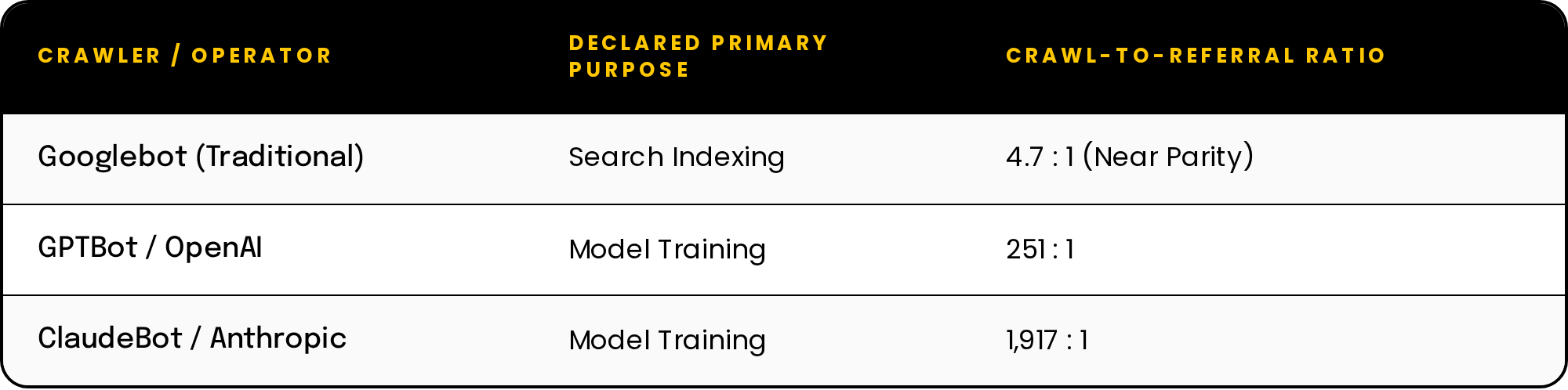
Crawl-To-Referral Rations
Across B2B SaaS and agency web properties, AI-related bots now account for 38% of all incoming bot requests. Of those, 72.9% go directly to the HTML (3). For a small team, the concern is credit. When AI training crawlers ingest a firm's proprietary methodology or original research, that work becomes part of what the model learns. The firm earns no attribution, citation, or client lead in return. Credit also depends on your pages. If the code doesn’t say who the work belongs to, credit may not be given.
You can control this with a few deliberate settings.
The Crawler Purpose Split: Training vs. Search Indexing
A common mistake in 2026 is treating AI crawlers as one category. Major AI vendors now split their crawlers by purpose. Some train AI models. Others build a search index or fetch pages when a user asks [4]:
OpenAI: Runs one crawler to train its AI models, a second to build ChatGPT's search index, and a third to fetch pages when a ChatGPT user asks.
Anthropic: Splits its crawlers the same way. One trains Claude, one builds Claude's search index, and one fetches pages when a Claude user asks.
Google & Apple: Each offers a dedicated opt-out control for AI training. Using it does not affect traditional Google Search or Siri indexing.
Your robots.txt file is a text file that tells crawlers which pages they may read. Blocking a training crawler there tells the AI company not to use your content for model training. It has no effect on search visibility unless you also block the search crawler.
Site owners adopt this split quickly. Data from a large website security and delivery provider shows that OpenAI's training crawler is disallowed 2.33 times for every allow directive, a 2.33:1 block-to-allow ratio. Anthropic's training crawler sits at 2.39:1 against. Search and retrieval crawlers get the opposite treatment. OpenAI's search crawler sits at a 0.94:1 block-to-allow ratio, so it is allowed more often than blocked. ChatGPT's user-request crawler is allowed at 1.12:1, and Google's search crawler is allowed at 1.11:1 [5].
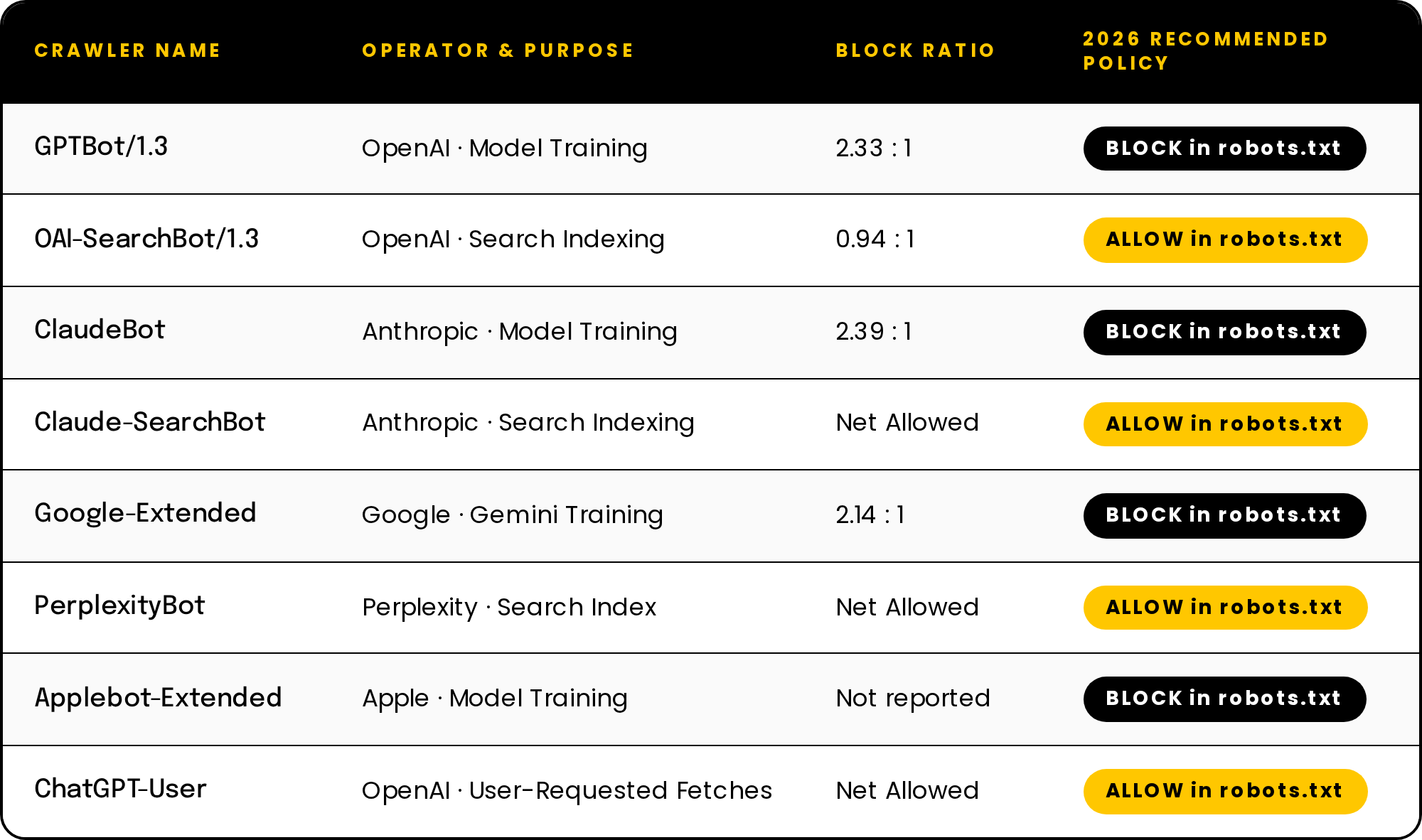
Crawler Policy
Protecting Thought Leadership IP vs. Winning AI Citations
For agencies and boutique consulting firms, specialized intellectual property sets them apart. A founder-led publishing strategy builds market authority. AI training crawlers can ingest that copy and absorb its logic. The AI tool can then present that logic to buyers without attribution.
A common worry among agency founders is that blocking a training crawler like ChatGPT's will remove their firm from AI search answers. Suff Digital's September 2026 study finds otherwise: 67% of frequently cited websites that block ChatGPT's training crawler still appear as sources in ChatGPT answers (compared to 73% of unblocked sites) [6]. ChatGPT retrieves citations through search indexes, cached web pages, and third-party partners. It does not rely only on what the model learned in training.
Blocking ChatGPT's training crawler does carry a measurable trade-off. Websites that block it receive an average of 22.6 ChatGPT citations. That is 29% lower than the 31.8 citations earned by sites that allow it [7].
THE CITATION TRADEOFF DATA:
Sites Allowing ChatGPT's Training Crawler: 31.8 Average ChatGPT Citations
Sites Blocking ChatGPT's Training Crawler: 22.6 Average ChatGPT Citations (29% Lower)
Key Takeaway: Blocking ChatGPT's training crawler keeps your proprietary frameworks out of AI model training. It lowers total citations by about 29%. Allowing OpenAI's search crawler keeps your site discoverable in search.
For your firm, this 29% reduction is the cost of keeping proprietary copy out of AI model training. For public marketing content and client-facing frameworks, the best balance is to allow search crawlers and disallow training crawlers. This protects your IP and keeps prospective clients able to find you.
Infrastructure Controls & Technical Pitfalls
It is not enough to rely only on robots.txt because it is advisory. The robots.txt file asks crawlers to follow your rules but cannot enforce them. Some scrapers ignore those rules. To stop them, use a website firewall or block their network address ranges.
BEFORE YOU CHANGE SECURITY AND DELIVERY SETTINGS: Some security and delivery providers offer a setting that blocks AI training crawlers. If it also covers crawlers that serve both search and training, it can block Google, Microsoft (Bing), and Apple from crawling your site for search. Check how your provider handles this. Add exceptions for those search crawlers first, so your organic search visibility stays intact [8].
Also, an llms.txt file does not protect your work. It is meant as a guide that AI tools read while they answer a question. It does not restrict crawling or opt you out of training [9]. Research also suggests AI tools rarely read the file. A June 2026 analysis of 137,210 domains found that 97% of llms.txt files were never read [10].
The 4-Step Actionable Framework for Small Firms
Agency leaders can control AI crawler access in four steps [11]:
Set Separate Rules for Training and Search Crawlers: In your robots.txt file, disallow the training crawlers from OpenAI (GPTBot), Anthropic (ClaudeBot), Google (Google-Extended), and Apple (Applebot-Extended). Allow the search and user-request crawlers from OpenAI (OAI-SearchBot, ChatGPT-User), Anthropic (Claude-SearchBot), and Perplexity (PerplexityBot).
Protect High-Value IP Behind a Login: Do not rely on robots.txt for proprietary data or unpublished frameworks and methodologies. Protect these assets with a login, a gated download, or website firewall rules. Published thought leadership stays public so search can cite it.
Check Your Firewall Rules Against Your Search Settings: If you use a website security service or your host's firewall, confirm that settings meant to restrict AI training do not block multi-purpose crawlers from Google, Microsoft (Bing), and Apple. Those crawlers handle standard search indexing.
Audit Your Crawler Settings Quarterly: AI companies often update their crawler names, IP address ranges, and search index systems. Each quarter, review your server logs, referral sources, and robots.txt file. Keep them aligned with your agency's business goals.
Need help putting these steps in place? Sixbees Consulting works with small agencies on exactly this. The Rapid Exposure Check assesses whether AI crawlers can find and credit your work. The Discoverability Audit maximizes your visibility in AI search while securing your intellectual property. AI Readiness & Digital Governance provides ongoing advising on secure generative AI adoption. Let's discuss.