
Meeting the Dual Demands of AI and digital Accessibility
Shifting online expectations are forcing organizations to rethink how they present information online. The Department of Health and Human Services recently introduced strict accessibility mandates under Section 504. This represents the first major update to these rules in fifty years. The updated regulations require recipients of federal funding to meet Level AA standard protocols of the Web Content Accessibility Guidelines, commonly known as WCAG 2.1. This mandate covers websites, mobile applications, and other web-facing assets.
Fortunately, the path to legal readiness and modern visibility relies on the same principle. The exact presentation layout that supports human assistive tools also allows cutting-edge artificial intelligence agents to read, summarize, and retrieve your data.
To win in this landscape, your business must design for Universal Readability. This strategy optimizes your online footprint for large language models and human users at the exact same time.
Understanding the Reach of Section 504
The revised rule targets any entity receiving federal funding. This criterion means the rules apply far beyond public institutions. Private organizations are subject to these guidelines if they receive research grants or payments from Medicare and Medicaid.
Covered entities include:
Hospitals, healthcare networks
Outpatient clinics and single office healthcare practices
Medical schools and clinical research institutions
Insurers and healthcare payers
Long-term care facilities
Community health centers
Medical and diagnostic laboratories
The scope of the rule goes beyond a standard homepage. The mandate applies to your entire online ecosystem.
Covered assets and interfaces include:
Patient-facing portals
Billing statements and payment tools
Telehealth software platforms
Electronic intake forms
Check-in and way-finding kiosks
Static electronic documents like clinical summaries
Medication guides and patient-facing instructional sheets
Third-party vendors are also subject to this rule. They must meet these guidelines if they provide digital services or products on your behalf.
Federal enforcement operates on a strict timeline based on organization size. Covered entities must audit and update their entire virtual presence before these mandatory milestones:
May 11, 2027 for organizations with fifteen or more employees.
May 10, 2028 for organizations with fewer than fifteen employees.
Achieving complete operational transparency across an entire network of portals and legacy documents requires immediate planning. Waiting until the final months introduces immense organizational risk.
The Intersection of Human Accessibility and AI Readability
Artificial intelligence models and assistive technologies read data the same way. Both platforms scan information linearly, semantically, and structurally. What makes your data discoverable to an AI engine through Answer Engine Optimization is also what makes it accessible to a person using a screen reader. Proper semantic frameworks, clear heading hierarchies, and descriptive alternative text are the foundation of modern visibility.
Modern conversational AI assistants rely on building a semantic scene graph. They build this graph directly from the underlying data models of a website.
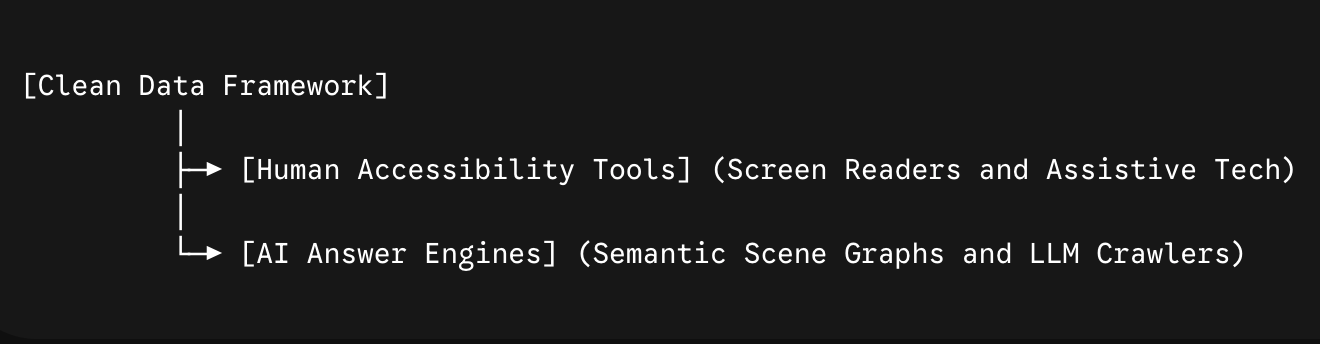
Diagram showing how the same data framework is consumed by accessibility tools and answer engines
Following these protocols ensures that your digital environment is fully operable and perceivable. When you optimize a patient portal or billing interface with these frameworks, you create a seamless experience. Large language models use this architecture to interpret your pages. By making electronic spaces accessible to human assistive technologies, you make your operational information AI-ready. Intelligent agents can then accurately navigate your properties to answer patient queries. They can easily handle prompts regarding how to update insurance information or submit a payment.
Tangible Marketing and Business Rewards
Investing in universal readability brings immediate commercial advantages. Recent SEO reporting states that sixty percent of searches now end without a click to a website. So the primary marketing goal has shifted. Instead of aiming to appear in a list of search links, you must aim to appear directly inside AI-generated answers.
Accessibility enhancements also drive traditional search performance. An industry report found that nearly three-quarters of websites see an increase in organic traffic after adding accessible architecture solutions. These properties experience an average traffic boost of twelve percent.
Eliminating Information Blocks
Updating your data presentation simultaneously resolves two distinct operational problems.
It helps AI answer engines find and cite your brand.
It also allows human users to navigate your interfaces without friction.
Sixbees Consulting uses enterprise-grade intelligence tools to analyze your online ecosystem. We look at your virtual properties through a dual lens of usability and discoverability. Serving businesses across the Pacific Northwest, we help you transform informational debt into market authority. Our Discoverability Audit ensures your platforms remain highly comprehensible for the modern internet. Request a free strategic briefing to talk about your needs.